

If you want a short, no-nonsense reply: a 30 mph ebike gives you most commuter and suburban utility—fast cross-town rides, better overtakes, and a good balance of range and safety. A 40 mph machine (or S-pedelec/moped-class bike) is a different animal: it demands stronger brakes, more robust framing, often registration and insurance, and a rider ready for much higher kinetic energy and legal scrutiny. In short: 30 mph is practical; 40 mph is powerful — and costlier in regulation, safety, and wear. We'll unpack why below.
Definitions and technical baseline
What we mean by “30 mph ebike”
When I write 30 mph ebike I mean an electric bicycle that can assist (or propel) the rider up to roughly 30 miles per hour under typical load and conditions. That includes powerful Class 3 e-bikes in some jurisdictions and some high-performance pedal-assist models that cut off near this speed.

What we mean by “40 mph ebike” and S-pedelecs
A 40 mph electric bike usually sits beyond everyday e-bike classes. In Europe, the roughly equivalent fast category is the S-pedelec, capped at 45 km/h (≈28 mph) for pedal-assist classification, but many vehicles that reach ~40 mph (≈64 km/h) are categorized as mopeds or motorcycles and face stricter rules. Several countries classify high-speed e-bikes as L1e-B or similar and require licenses and registration.
Legal & regulatory landscape: where speed changes classification
Europe: S-Pedelec and L1e categories
In the EU and many European states, bikes that offer assistance up to around 45 km/h (≈28 mph) are typically treated as S-pedelecs and are often not considered simple bicycles. Faster or more powerful machines can be placed into vehicle classes like L1e-B (throttle-assisted mopeds) and they require registration, insurance, and a licence in many countries. This legal distinction matters: ride one on a bike path without meeting requirements, and you may be breaking the law.
United States: classes, state differences, helmet and registration rules
In the U.S., a commonly used class system defines Class 1 and 2 e-bikes (assist or throttle up to 20 mph) and Class 3 (pedal-assist up to 28 mph). But beyond that, things get messy: e-bikes that go faster than 28 mph or have much higher power can be regulated as motor-driven cycles, require registration, or be restricted by local ordinances. Helmet laws, age minimums, and where you can ride vary by state and city — check local rules before buying.
Performance trade-offs: speed vs range, power, and efficiency
How speed affects range
Speed is an energy tax. Aerodynamic drag rises roughly with the square of speed, which means electrical power to overcome air resistance increases quickly as you go faster. Practically, pushing from 20 mph to 30–40 mph can dramatically reduce range — sometimes halving or worse — depending on wind, rider position, and terrain. Industry guides and tests show that sustained riding at higher speeds can more than double battery drain versus moderate speeds. If you need predictable long range, a 30 mph setup used sensibly will usually out-distance a 40 mph ride for the same battery capacity.
Motor power, gearing, and real-world top speeds
Top speed isn’t just about wattage. Controller limits, gearing, motor efficiency at high RPM, and thermal management all matter. Bikes designed to sustain higher speeds require heavier-duty motors, controllers, and batteries—adding weight, cost, and complexity.
As an example of this higher-duty category, moped-style eBikes like the VICTRIP R6 Pro 1500W Moped Style ebike are engineered around stronger frames, larger motors, and motorcycle-inspired geometry to cope with higher sustained speeds—placing them firmly closer to the 35 mph end of the spectrum rather than everyday commuter e-bikes.
TOP PICK
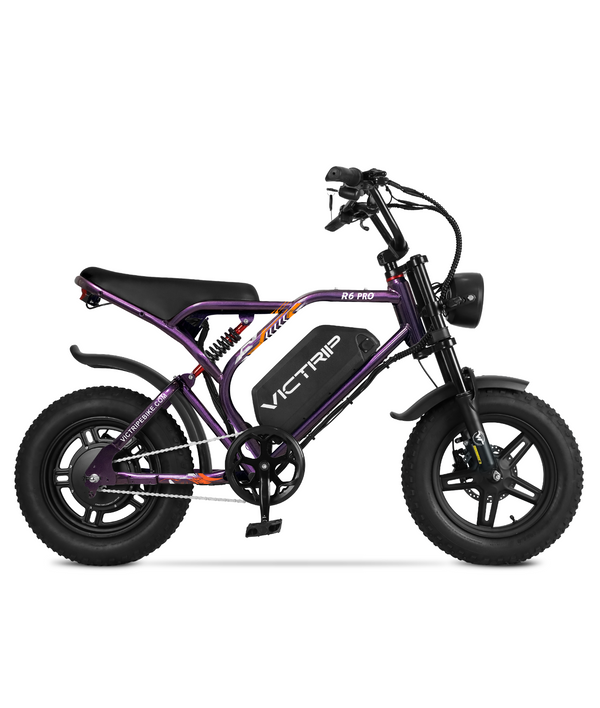
VICTRIP®R6 Pro 1500W Moped Style EBike
$1,099.00
Safety implications: stopping, handling, and crash energy
Stopping distance at 30 vs 40 mph
Kinetic energy rises with the square of speed; going 40 mph packs roughly (40/30)² ≈ 1.78× the kinetic energy of 30 mph. That increase means longer stopping distances and much more force in a crash. Practical braking and stopping charts show marked differences: a bike stopping from 30 mph will require substantially less distance and force than from 40 mph — bad news if you need to brake quickly in urban traffic. Good brakes, tires, and rider training are non-negotiable for higher speeds.
Rider skill, protective gear, and infrastructure
Going faster demands better skill: anticipating traffic, smoother inputs, and higher-quality PPE (helmet rated for higher impact, gloves, jackets). At 40 mph you begin to need motorcycle-grade considerations (armor, reinforced frames) to manage crash forces and protect yourself.
Practical use-cases: when 30 mph is enough — and when 40 mph helps
-
Commuting in mixed urban/suburban areas: 30 mph is usually plenty. It keeps you fast on roads while remaining manageable on bike lanes and suburban streets.
-
Long rural links or fast courier runs: a higher sustained top speed (closer to 40 mph) can be justified when there are uninterrupted stretches of road and you need to shave minutes off long trips.
-
Highway or fast arterial roads: many places ban high-speed e-bikes from bike lanes; if you intend to use fast roads regularly you may need a 40 mph capable vehicle that’s legally classified for that environment — and licensed/insured accordingly.
-
Recreational thrill riding: 40 mph is fun, but it’s a different category of risk and cost.
Buying checklist: how to choose between a 30 mph ebike and a 40 mph one
-
Where will you ride? If most riding is city streets and bike paths, prefer 30 mph models that stay lawful and practical.
-
Do you need range or top speed? For longer distance on mixed roads, prioritize range and efficient cruising rather than raw top speed.
-
Local laws & insurance: if 40 mph puts you into moped/motorcycle class locally, factor in licensing, plates, and insurance.
-
Components: for 40 mph, get hydraulic disc brakes (large rotors), high-quality tires, and a robust frame.
-
Battery and motor specs: ask for continuous power rating, not just peak watts; continuous output matters for sustained high speeds.
-
Serviceability & parts: high-speed systems are heavier on brakes and drivetrains — check service networks.
Maintenance and insurance considerations
Fast e-bikes mean more stress on mechanical parts (brakes wear faster, tires heat up more, bearings see higher loads). Insurance and registration may be mandatory for 40 mph machines in many jurisdictions — add that to TCO (total cost of ownership). Some U.S. states are moving to stricter rules for modified or high-power e-bikes, so keep receipts and certifications from manufacturers when required.
Cost comparison: price, running costs, fines, and compliance
Expect higher upfront cost for 40 mph bikes (stronger frames, bigger motors, better brakes). Running costs — tires, pads, high-performance batteries — also increase. Don’t forget potential fines or fees if your bike is classified as a motor vehicle and you fail to register it. Factor in safety gear (certified helmet, protective clothing) — that cost can be sizeable but is essential.
Recommendations: who should pick which speed?
-
Choose 30 mph if: you mostly commute in towns, want better range for the battery size, want simpler legal status in many areas, and prefer lower maintenance costs.
-
Consider 40 mph if: you frequently ride fast rural stretches, have the training and PPE, can and will comply with licensing/insurance, and want the raw speed for specific use cases (rapid courier routes, fast country commuting).
Conclusion: balancing speed, safety, and sense
Speed is seductive, but it's also a multiplier of costs, regulation, and risk. A 30 mph ebike will serve most riders brilliantly: it’s fast enough for efficient commutes, kinder to battery life, and — in many places — easier to keep legal. A 40 mph machine has its place, but it’s a commitment: better components, rider skill, legal compliance, and higher running costs. Choose based on where you ride, how much risk you accept, and whether you’re ready for the added responsibilities that come with higher speed.
FAQs
Is a 30 mph ebike legal everywhere?
No. A 30 mph ebike often sits near Class 3 thresholds in the U.S. and can be treated differently by local law. Always check state and city rules.
How much range difference will I see between 30 mph and 40 mph riding?
Expect a substantial drop in range at 40 mph versus 30 mph because aerodynamic drag climbs steeply. In real tests, riding significantly faster can cut range by 30–60% depending on conditions.
Do I need motorcycle insurance for a 40 mph bike?
Sometimes. Many jurisdictions classify bikes that exceed certain speeds/power as motor vehicles; they may require registration and insurance. Check local transport authority rules.
Are the brakes on normal e-bikes enough for 40 mph?
Usually not. For safe 40 mph operation, you want high-end hydraulic disc brakes, larger rotors, and tires rated for the speed. If the bike wasn’t engineered for those speeds, upgrades are necessary.
Can I legally ride an S-pedelec on bike lanes in Europe?
Often not without meeting special requirements (registration, insurance, helmet rules). Many countries restrict S-pedelecs from cycle paths; local rules vary.
Share:
Electric Trike with Reverse Gear: Is It Useful?
EBike Battery Replacement Cost: Is It Worth It?