

A folding ebike is a compact, motor-assisted bicycle that folds to save space and make mixed-mode commuting (bike + train, bike + car) possible. If you live in a small apartment, use public transit, or need to stow your ride at work, a folding ebike can be transformative. It combines the convenience of a compact footprint with the mechanical advantage of electric assist, letting you travel farther, arrive less sweaty, and carry more on urban trips.
Real-world testers and roundups continuously show that folding models now span budget to premium segments — from commuter-focused lightweight folders to powerful long-range fat-tire compacts — so you can find one tuned to your unique daily pattern. For example, popular commuter folders like the Lectric XP4 and Ride1Up Portola emphasize value and compactness, while higher-capacity models like the VICTRIP TITAN S push range and power.
Know the keyword: what “folding ebike” really means
When we say folding ebike we mean a rideable electric bike with a folding frame or hinge mechanisms that reduce overall volume for carrying or storing. Some folders fold into a package you can lift into a car trunk; others are compact but heavy and need wheels for rolling.
Important nuance: foldability doesn't always equal lightness. Many folding ebikes prioritize durability and battery capacity, which increases weight. Knowing this distinction will save you from picking a bulky “foldable” model that’s impractical to carry.

Where you’ll ride: terrain, distance, and commuting patterns
Your typical ride profile decides almost everything else.
-
Short, flat urban hops (1–5 miles): prioritize compact fold, light weight, and agility.
-
Mixed-mode commutes (train + bike): easy folding, carry handle, and secure latch matter.
-
Hilly or long suburban commutes (10+ miles): pick more motor power and larger battery capacity.
-
Rough trails or beach paths: look for fat tires and suspension.
If you’re unsure, track a week of trips with your phone mapping app: how many miles, average speed, and how many sharings/transport transfers you do. That simple data will point you to a target battery and motor spec.
Power & performance: motors, watts, and hill-climbing
Motor basics (what to look for)
-
Hub motors are common in folders: compact and affordable.
-
Mid-drive motors give better hill performance and weigh differently but are rare on true folding frames.
-
Rated power (continuous watts) and peak watts are marketing variables — a 500W nominal motor can behave very differently across brands.
In practice: a 250–500W motor will handle flat urban riding and moderate hills; 750W and higher provide brisk acceleration and confidence on steep grades. The Ride1Up Portola, for example, is notable for offering a 750W motor at a value price, giving it an edge in hill climbing among budget folders.
Sensors and responsiveness
-
Cadence sensors respond when you pedal; they’re simpler and cheaper.
-
Torque sensors sense pressure on the pedals and provide smoother, intuitive assistance (preferred for natural feel).
If you value a natural ride and plan long distances, prioritize torque-sensor-equipped models. For short city hops, a cadence setup is often perfectly fine.
Battery & range: realistic expectations
Battery capacity (Wh) primarily determines real-world range, but terrain, rider weight, assistance level, and speed heavily influence outcomes.
Rule of thumb for daily planning:
-
250–400 Wh — 15–30 miles typical in mixed assist
-
400–700 Wh — 30–60 miles typical
-
700Wh+ — long-range options 60+ miles or specialist big-battery folders
Manufacturers sometimes quote optimistic ranges. Look for real-world tests or user reports for realistic guidance. Some folding models now offer modular or optional larger batteries — the VICTRIP family is available in different battery sizes and motor options, letting buyers balance weight vs distance.
Charging logistics: charging time and whether the battery is removable for indoor charging matter if you live in an apartment without street-level sockets.
Folding and portability: size, weight, and fold mechanism
A folding ebike’s value is in its fold. Consider:
-
Folded dimensions: does it fit your car trunk, under your desk, or in a train luggage rack?
-
Fold time: how many steps and how intuitive is the latch?
-
Carry weight & handles: can you comfortably lift it?
-
Securing when folded: does it lock shut so wheels won't spin?
Measure the space where you’ll store it. If you plan to carry it weekly up stairs, prioritize lightness over long-range battery. If you’ll mostly roll it on a wheeled cart, folded volume might be more critical than weight.
Build, frame, and load capacity
Frame material (aluminum vs steel vs alloy mixes) determines durability and weight. Aluminum is common for folders due to strength-to-weight. Key points:
-
Payload rating: many folders support 220–400+ lb; check manufacturer specs if you’ll carry cargo or a passenger.
-
Rear racks and mounts: integrated racks increase commuting practicality.
-
Corrosion-resistant finishes if you live in rainy or coastal climates.
The VICTRIP TITAN S, for instance, advertises high payload and heavy-duty construction with fat tires and large battery options — which suits riders wanting ruggedness and cargo capacity.
Brakes, tires, and suspension: safety first
-
Brakes: Hydraulic disc brakes are preferred for consistent stopping power, especially with heavier batteries and higher speeds. Mechanical discs are acceptable on lighter, lower-power folders.
-
Tires: Narrow tires are efficient; wide or fat tires give comfort and grip on rough surfaces.
-
Suspension: Front suspension forks or seatpost suspension reduce fatigue on bumpy urban routes.
If your commute includes descents or poor road surfaces, prioritize stronger brakes and some suspension.
Legal class & local regulations
E-bike classes (commonly Class 1–3 in the U.S.) determine where you can legally ride and the max assisted speed. Check local laws for:
-
Allowed speeds on bike lanes and trails
-
Throttle legality (some places restrict throttle use)
-
Registration or helmet rules for high-powered models
If commuting in regulated infrastructure (national parks, trains, or certain bike lanes), ensure the folding ebike’s class and speed conform to rules to avoid fines or confiscation.
Practical features: lights, racks, display, throttle
A commuting-oriented folder should include:
-
Integrated lights (front/back)
-
Rear rack or mounting points
-
Waterproof-ish display and connectors
-
Fenders and built-in kickstand
-
Removable battery for charging/storage
These everyday conveniences make a folding ebike truly useful rather than just novel.
Price, warranty, and servicing
Total cost includes purchase price, shipping/import fees, and long-term service. Compare:
-
Factory warranty (battery, motor, frame)
-
Availability of spare parts and local service providers
-
Return policy and trial period
Brands like Lectric, Ride1Up and VICTRIP have built reputations for accessible support and good value, which can be decisive for first-time buyers.
Model comparison & suggested picks
Below is a concise comparison table to orient you (specs indicative; always verify current model details):
| Model | Motor (nominal) | Typical Battery | Folded weight | Best for |
|---|---|---|---|---|
| Lectric XP4 | 500W / 750W options | Variable (10–17.5Ah options) | ~60–70 lb | Value + versatility. Good all-round commuter. |
| Ride1Up Portola | 750W | 500–643 Wh options | ~45–55 lb | Strong hill-climbing at budget price; commuter with extras. |
| VICTRIP TITAN S | 1000W (peak 1500W) | Very large (40–60Ah variants) | Heavy (but foldable) | Long-range, heavy-duty, fat-tire off-road capable. |
| Brompton C-Line Explore | ~250W (removable battery) | Smaller pack | ~32 lb | Ultra-compact, train-friendly (premium) — best for minimal storage. (See Tom's Guide roundup.) |
How to interpret this: choose the row that matches your daily pattern: lightweight + compact for mixed-mode commuters, or heavy + powerful for long rural stretches.
TOP PICK
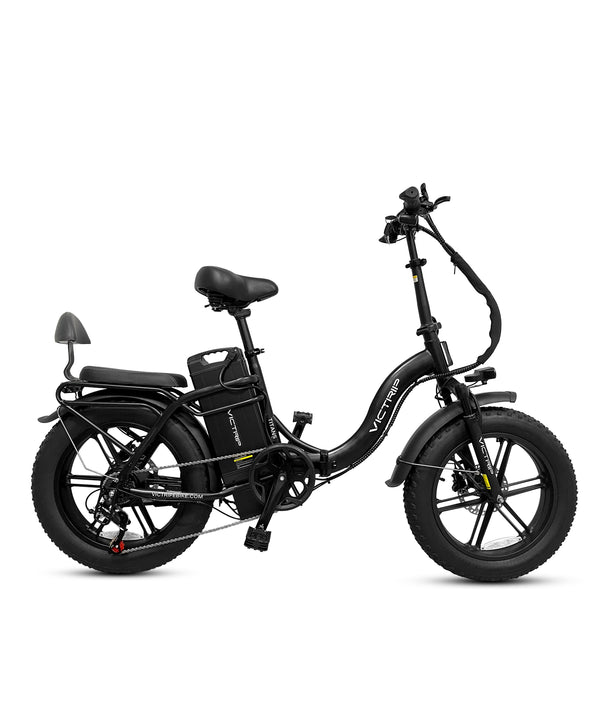
VICTRIP®TITAN S 1000W Ebike
$1,499.00
How to test-ride a folding ebike (checklist)
When you test-ride:
-
Time the folding/unfolding — do it cold, and again after 30 minutes.
-
Try different assist levels; test hill starts and stops.
-
Load a small bag or pannier to simulate commuting weight.
-
Test battery removal and charging.
-
Check braking from 20 mph (if permitted).
-
Inspect welds, hinges, and closures for play or creak.
Bring ear protection and legal ID; some shops require a waiver.
Maintenance & storage tips
-
Keep the battery at ~30–80% for long battery life when storing.
-
Lubricate hinge pins monthly if you ride frequently in wet conditions.
-
Tire pressure checks before long commutes preserve range.
-
Fold and store indoors if possible — batteries and electronics fare better out of extreme temperatures.
Buying used vs new
Used Ebikes can save money but check:
-
Battery health (ask for current capacity or service history)
-
Evidence of drops or hinge damage
-
Service logs and whether the original owner rode in harsh weather
If unsure, consider a pre-purchase inspection at a reputable bike shop.
Accessibility & special considerations
For riders with limited mobility or seniors:
-
Step-through frames and adjustable crank heights help on/off comfort.
-
Lower seat-to-ground distances, upright geometry, and torque sensors make for easier starts.
-
Consider models with built-in throttle if pedaling is intermittent.
Sustainability and battery disposal
Responsible owners:
-
Recycle old batteries at certified e-waste centers.
-
Prefer manufacturers with take-back or recycling programs.
-
Avoid deeply discharging batteries repeatedly; that shortens lifespan.
Conclusion: pick the one that actually solves your problem
A folding ebike is a toolbox piece: buy the one that fits your actual constraints — storage, folding frequency, stairs, distance, and terrain. Don’t chase top specs if you only need a compact runaround; don’t buy the lightest compact if you need range and power every day.
If you want a balanced, widely recommended choice for most commuters, consider proven value models like the Lectric XP4 (flexible battery and motor options). If you need aggressive hill-climb and value, the Ride1Up Portola is often highlighted in independent reviews for its 750W motor and feature set. For heavy-duty long-range needs, specialist models like the VICTRIP TITAN S show how far the category has expanded — though at the cost of extra weight. Always test-ride and evaluate how simple or complex the fold is for your routine.
FAQs
Is a folding ebike heavy to carry upstairs?
Many are heavy — often 35–70+ lb. If you must carry stairs frequently, prioritize lighter folders (like Brompton C-line variants) or models with wheeled travel-cases. Consider your ability to lift safely; a heavy foldable designed to be wheeled is not the same as a light one you can carry.
Can I bring a folding ebike on public transit?
A: Usually yes, but check your transit authority’s size/weight rules and whether the battery is regulated. Smaller folded dimensions increase your chance of acceptance.
How far will a folding ebike go on one charge?
Typical real-world ranges vary 15–60+ miles depending on battery Wh, assist level, rider weight, and terrain. Manufacturer numbers can be optimistic; look for user tests.
Do folding ebikes require special maintenance?
Maintenance is similar to other eBikes: brakes, drivetrain, and battery care. Hinges need attention; check for play and lubricate hinge pins regularly.
Are powerful folding ebikes (750W+) legal?
It depends on local law. Some jurisdictions restrict motor power or top assisted speeds; check local e-bike rules before purchasing a high-powered folder.
Share:
Best Folding eBikes for Commuters Who Hate Traffic
Is VICTRIP a Good Electric Bicycle Brands? Honest Buyer’s Guide